.svg?rev=0123a45359b34a45b72f615f84c63d11&hash=D9D267D4F8A003D6A105C987E125D147)

At a Glance
- In June 2026, we initially published this article, which provided a comprehensive country-by-country overview of how EU member states were progressing toward transposition of the Product Liability Directive (EU) 2024/2853 (the PLD) ahead of the 9 December 2026 deadline. We have now updated the article to reflect material developments that have taken place since its original publication.
- The most notable development since our original article is that Croatia has become the second EU member state (after Hungary) to complete transposition of the PLD. In addition, several member states that had not previously taken meaningful steps have now published draft transposition legislation, including Cyprus, Lithuania, and Poland. These developments narrow the group of member states that have made no significant progress; although a substantial number — including France and Spain — remain in that category.
- Meaningful national divergences are already emerging among member states that have published draft legislation. These divergences are concentrated in certain areas, including the development risk defence, the treatment of nonmaterial damages, and the scope of disclosure obligations.
- Even where the PLD aims for full harmonisation, the early legislative activity reveals notable differences in implementation which may give rise to forum shopping and inconsistent outcomes across jurisdictions.
- With the 9 December 2026 deadline now approximately three months away, companies operating across the EU should continue to monitor national transposition closely and prepare for the new regime. Key steps include reviewing product safety documentation and post-market surveillance processes and ensuring that contractual arrangements with component suppliers and distributors adequately allocate responsibilities and risks under the revised framework.
Our June 2026 article addressed the expanded scope — covering software and artificial intelligence, its claimant-friendly burden-of-proof presumptions, and broadened categories of recoverable damage, among other significant reforms — of the European Union's (EU) new Product Liability Directive (EU) 2024/2853 (the PLD).
Since that publication, the transposition deadline of 9 December 2026 has drawn considerably closer, and important developments have taken place at both the EU and national levels.
This article provides an update on those developments, with a particular focus on how individual EU member states are progressing — or in many cases, not progressing — towards implementation.
Developments since April 2025
Meaningful national divergences are already emerging among member states that have published draft legislation. These divergences are concentrated in certain areas, including the development risk defence, the treatment of nonmaterial damages, and the scope of disclosure obligations.
One example is that both Sweden and Finland have dropped the word "excessive" from the threshold for triggering the presumptions of defectiveness and causation under Article 10(4)(a) of the PLD, which establishes those presumptions partly on the basis that the claimant faces "excessive difficulties" due to technical or scientific complexity. By removing this qualifier, those member states may make it materially easier for claimants to establish the presumptions — a subtle but consequential textual departure from the PLD's language that other member states have not replicated.
The European Justice Forum (EJF), a Brussels-based organization representing business interests, has called on the European Commission to issue guidance clarifying the interpretation of key provisions, particularly those relating to the presumptions of defectiveness and causation under Article 10. At a roundtable held in Brussels in March 2026, senior business leaders and legal experts warned that inconsistent national implementations risk fragmenting the single market and increasing litigation risk.
Member State Transposition Progress
The 27 EU member states are at markedly different stages in transposing the PLD. What follows is a country-by-country overview illustrating the state of play across the EU.
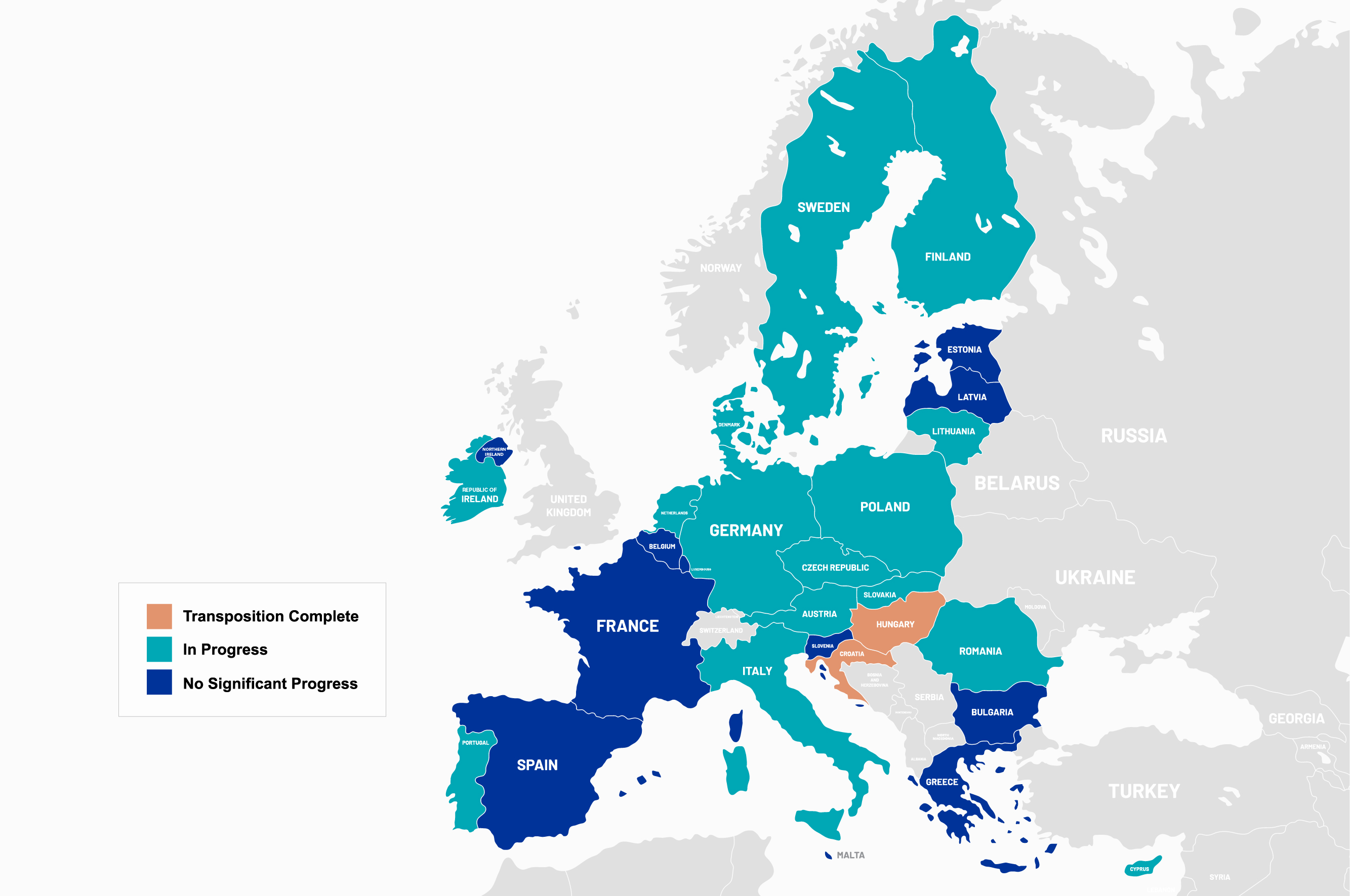
Transposition Complete
Hungary has fully transposed the PLD into national law. The legislation was adopted on 16 December 2025. The rules will take effect for products placed on the market on or after 9 December 2026. Hungary's implementing law is broadly aligned with the PLD. Hungary has adopted the development risk defence but has limited its use in relation to pharmaceuticals.
Croatia has also completed transposition of the PLD. The European Commission has recorded Croatia's notification of national transposition measures. Croatia's implementing legislation aligns with the requirements of the PLD and was adopted on 24 June 2026.
In Progress
Austria. No draft legislation is yet available, but the relevant federal ministries — including the Federal Ministry of Social Affairs, Health, Care and Consumer Protection and the Federal Ministry of Justice — have begun preparatory work on the transposition process.
Cyprus, Lithuania, and Poland have published bills transposing the PLD, moving beyond the preparatory stage. Cyprus has opted to retain the development risk defence.
Czech Republic published a bill transposing the PLD. The bill expanded the definition of a product and defendant and retained the development risk defence, reducing the burden of proof for claimants.
Denmark published a draft Product Liability Act in January 2026, with a consultation that closed in February 2026. The draft closely tracks the PLD, retains the development risk defence, and notably proposes maintaining Denmark's existing fault-based distributor liability regime within the PLD framework. Under these rules, once an injured party establishes defect, damage, and a causal link, the burden shifts to the distributor to prove the absence of fault or negligence. Alongside the shifted burden of proof, the Act will make it easier to bring claims because of the abolition of the deduction of DKK 4,000 for consumer property damage. The proposed legislation also introduces liability for the destruction of or damage to data not used for commercial purposes.
Finland published a draft bill in February 2026, with a consultation period that closed in March 2026. Finland has confirmed that it will not include the development risk defence, consistent with its position under the previous legislation. Finland has also dropped the word "excessive" from the threshold for triggering the presumptions of defectiveness and causation under Article 10(4)(a), which may make it easier for claimants to invoke those presumptions.
Germany published a draft bill — the draft Act on the Modernisation of Product Liability Law — in September 2025. This was revised in December 2025 following a consultation. The bill aims for a close, one-to-one transposition of the PLD. It retains the development risk defence (except for genetic engineering products), allows recovery of nonmaterial damages under general civil law principles, and fully implements the PLD's disclosure regime. It remains unsettled whether the separate fault-based liability under German tort law can still be invoked alongside the PLD. The German Bundestag held its first reading of the bill on 4 March 2026. The legislative process is well advanced and Germany remains on track to meet the 9 December 2026 deadline.
Republic of Ireland. The legislation transposing the PLD is being drafted as of August 2026. The government has indicated its intent to adhere to the 9 December 2026 deadline.
Italy. The legislative process has begun, and it is not expected that significant changes will be made to the text of the PLD.
The Netherlands published a draft implementation bill in April 2025, proposing amendments to the Dutch Civil Code. A public consultation closed in May 2025, and the bill has since been referred to the Council of State for advisory review. The Dutch government has retained the development risk defense and has not diverged significantly from the text of the PLD.
Portugal and Romania. Preparatory work is ongoing for the implementation of the PLD into national law.
Slovakia published draft legislation on 17 December 2025. The draft closely tracks the PLD.
Sweden. A consultation on proposed legislation closed in January 2026, and a government proposal is expected in autumn 2026. The draft retains the development risk defence but has been criticized by the EJF for its use of vague legal standards. Like Finland, Sweden's draft has dropped the word "excessive" from the relevant Article 10(4)(a) threshold, and the proposed defectiveness standard omits the PLD's formulation requiring compliance with mandatory safety requirements to be taken into account. The draft thus broadens liability beyond the requirements of the PLD, which will create additional heterogeneity among member states.
No Significant Progress
A substantial number of member states have not yet taken meaningful public steps toward transposition. These states are: Belgium, Bulgaria, Estonia, France, Greece, Latvia, Luxembourg, Malta, Slovenia, and Spain. With the December 2026 deadline now approximately three months away, it appears increasingly likely that a number of these member states may struggle to achieve timely implementation.
The UK is no longer an EU member state. However, Northern Ireland will implement the PLD in line with the requirements of the Belfast Agreement (also known as the Good Friday Agreement). Northern Ireland has not yet made any significant progress towards implementation.
Implications for Businesses
The varying transposition among member states carries practical implications for companies operating across the EU market. Even where the PLD aims for full harmonisation, the early legislative activity reveals notable differences in implementation. These divergences may give rise to forum shopping and inconsistent outcomes across jurisdictions.
Companies should continue to monitor national transposition closely and begin preparing for the new regime. Key steps include reviewing product safety documentation and post-market surveillance processes and ensuring that contractual arrangements with component suppliers and distributors adequately allocate responsibilities and risks under the revised framework.
We will continue to track and report on transposition developments as the December 2026 deadline approaches.