
Table of Contents
-
Snapshot: What's "Out" and What's "In"
-
NEOs: Just PEO and PFO
-
CD&A: Grab Your Red Pen
-
Compensation Tables: All New
-
Perquisites: Higher Threshold and Greater Flexibility
-
CEO Pay Ratio: US Only
-
Pay-versus-Performance: No CAP
-
Director Compensation: No Table but Still Disclose
-
Alignment with Filer Status Proposal: Reductions across the Board for NAFs, SRCs, EGCs
-
What's Next?
When Jim Moloney, the Director of the Division of Corporation Finance of the US Securities and Exchange Commission (SEC), recently stated that the forthcoming proposed rules on executive compensation disclosures would amount to a "major Ozempic diet," he was not joking! While there certainly will be various considerations to sort through, based on the proposed rules, future proxy statements will potentially be leaner and more focused on material topics.
The proposed rules on executive compensation disclosure that the SEC released on November 13, 2026 (Proposing Release Nos. 33-11455; 34-106873) reflect the most significant rewrite of Item 402 of Regulation S-K since 2006. The SEC's stated goals are to make executive and director compensation disclosure more principles-based, to reduce compliance burdens for companies, and to preserve the disclosure of material information to investors. This alert summarizes the more meaningful proposed changes (of which there are many).
Snapshot: What's "Out" and What's "In"
The following table provides a summary of the proposed changes, including disclosures that would be eliminated and those that would be retained or revised, for a company that is not currently subject to scaled disclosure as a smaller reporting company (SRC) or emerging growth company (EGC).
NEOs: Just PEO and PFO
Named executive officers would be limited to only those individuals who served as the PEO or the PFO at any time during the fiscal year. This would include those who acted in a similar capacity or in an interim, acting, or dual role. These individuals would be the NEOs regardless of the company's filer status.
As a result, the Proposing Release would eliminate the following from the list of required NEOs:
- The three most highly compensated executive officers other than the PEO and PFO
- Up to two additional individuals for whom disclosure would have been provided but for the fact the individual was not serving as an executive officer at the end of the last completed fiscal year
Limiting the NEO population would be a welcome change for many companies, especially for companies that have had transitions at the executive officer level and under the current rules could have more than seven individuals as NEOs. Of course, there would be ripple effects from this change across many other rules that merit consideration, including Form 8-K, the beneficial ownership table, and exhibits filed with a company's periodic reports.
CD&A: Grab Your Red Pen
Typically, the Compensation Discussion & Analysis (CD&A) section of a company's proxy statement is the longest section in the document. The Proposing Release aims to focus CD&A disclosure on the material principles underlying the company's executive compensation policies and decisions, as well as the most important factors relevant to the analysis of those policies and decisions. In this regard, the Proposing Release would scale back the required disclosure to three (instead of the current seven) topics and eliminate the list of 15 illustrative topics. The three topics of required disclosure would be:
- The compensation program's objectives in relation to corporate strategy
- The material compensation elements and how amounts are determined
- Whether and how the most recent say-on-pay vote affected compensation policies and decisions
The Proposing Release would retain the existing accommodation to omit target levels if disclosure would cause competitive harm.
One notable change under the Proposing Release would add to, rather than streamline, existing disclosure rules. Namely, non-GAAP financial measures disclosed in the proxy statement would be subject to additional disclosure and reconciliation requirements, as described in the table above.
EGCs and SRCs would continue to be exempt from providing a CD&A.
Compensation Tables: All New
The compensation tables would see some of the most significant changes under the Proposing Release. The Summary Compensation Table (SCT), Grants of Plan-Based Awards Table, Outstanding Equity Awards at Fiscal Year-End Table, Option Exercises and Stock Vested Table, Pension Benefits Table, and Nonqualified Deferred Compensation Table would be eliminated.
Instead, there would be three new tables: the Earned Compensation Table (ECT), the Granted Compensation Table (GCT), and the Status of Equity Awards Table (SEAT). The current SCT information would essentially be split and moved into the ECT and the GCT. The SEAT would combine aspects of the three current equity tables, tracking equity awards through their lifecycles, from grant to vesting or exercise. Certain prescriptive footnote requirements would be removed, but companies would need to include other material supplementary information as necessary to understand the information disclosed in the tables or disclose other material compensation. Large accelerated filers would be required to tag the three new tables using Inline XBRL.
Earned Compensation Table
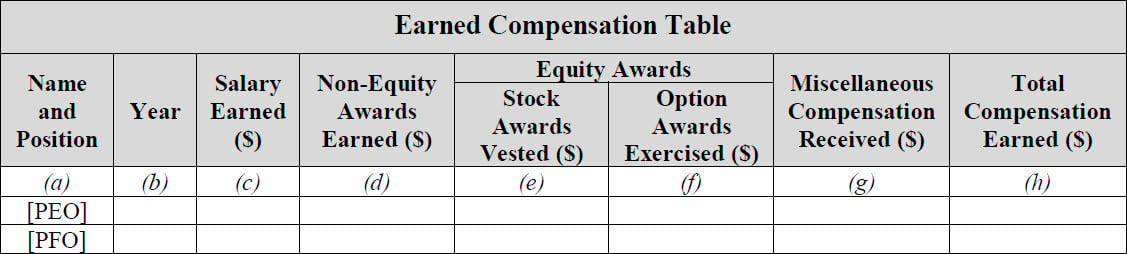
This table would reflect compensation outcomes, capturing compensation earned by the NEOs in the last three fiscal years (two years for EGCs and SRCs).
Column |
Proposed Disclosure |
|
Salary Earned |
The amount of salary earned during the year. |
|
Non-Equity Awards Earned |
Combines bonuses (such as discretionary bonuses, signing bonuses, retention bonuses, etc.) and non-equity incentive plan compensation. |
|
Value of Stock Awards Vested and Options Exercised during the Year |
Instead of reporting the grant date fair value of equity awards, would report the value of stock vested and options exercised during the year, calculated as of the date of vesting or exercise, similar to the amounts currently disclosed in the Option Exercises and Stock Vested Table. |
|
Pension and Deferred Compensation |
Eliminates disclosure of the change in pension value. Above-market nonqualified deferred compensation earnings would be moved to the new "Miscellaneous Compensation Received" column. |
|
Miscellaneous Compensation Received |
This column would replace the current "All Other Compensation" column and include the following categories:
|
Granted Compensation Table
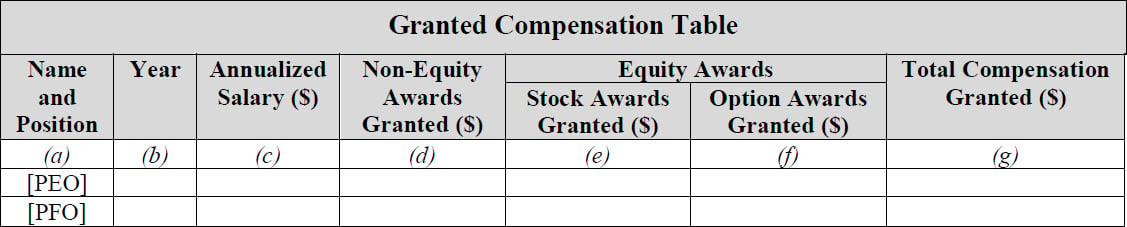
This table would report compensation granted to the NEOs over the last three fiscal years (two years for EGCs and SRCs), generally at target value, focusing on compensation opportunities rather than amounts ultimately earned.
Column |
Proposed Disclosure |
|
Annualized Salary |
Annualized dollar value of base salary as of the last day of the covered fiscal year. |
|
Non-Equity Awards |
This would change significantly:
|
|
Equity Awards |
Reporting would be similar to the current rules, including reporting the grant date fair value, except that certain grants may be reported in the year earned rather than the year granted, and performance awards would only be reported at their target level, with no requirement to footnote the maximum value. |
|
Total Compensation Granted |
All awards during the year would be aggregated by type, compared to the current requirement to separate each award into its own row in the Grants of Plan-Based Awards Table. The SEC states that the resulting Total Compensation Granted amount is intended to be similar to the concept of "total direct compensation." |
Status of Equity Awards Table
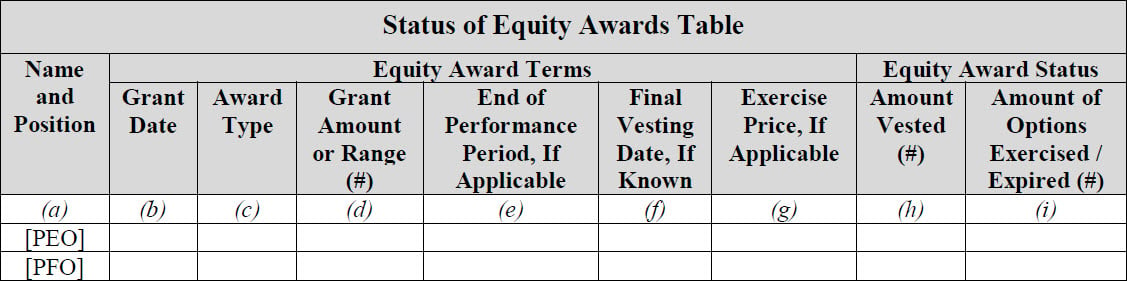
This table would track each equity award from the first year it is introduced in the Granted Compensation Table until after the award has either been reflected in the Earned Compensation Table as earned or otherwise has fully expired.
Column |
Proposed Disclosure |
|
Equity Award Terms |
For each award, would disclose the:
|
|
Equity Award Status |
For each award, would disclose the number of shares that have vested and the number of options that have been exercised or expired. |
|
As-of Date and Updating Requirement |
The table would generally be stated as of fiscal year end, but if the company elects to include a first-quarter equity award as prior-year compensation in the GCT, would need to report the terms and status of all equity awards as of the end of the first quarter of the next fiscal year. |
Perquisites: Higher Threshold and Greater Flexibility
Increased Threshold and De Minimis Fringe Benefit Exclusion
- The Proposing Release provides that perquisites and other personal benefits would need to be reported in the ECT only if their aggregate value for an NEO is $150,000 or more, an increase from the current $10,000.
- The Proposing Release would allow exclusion of any items that qualify as de minimis fringe benefits under Internal Revenue Code Section 132(a)(4) — e.g., occasional group meals, holiday gifts of nominal value, or personal use of a company phone — such that those items would not be counted in determining whether the threshold is met.
- Tax gross-ups, including those for perquisites, would continue to be included, with no minimum disclosure threshold.
Greater Flexibility in Determining Perquisites
- The Proposing Release would retain the current "integrally and directly related" test for determining whether an item is a perquisite, but would give companies more flexibility in determining whether a benefit is a perquisite or not. The rule would provide that:
- An item is not a perquisite or personal benefit if it is integrally and directly related to the performance of the executive's duties, as determined by the company, so long as such determination is reasonable and made in good faith.
- An item is a perquisite or personal benefit if the company determines, reasonably and in good faith, that it is not integrally and directly related to those duties and it confers a direct or indirect personal benefit, unless generally available on a nondiscriminatory basis to all employees.
- The Proposing Release would also eliminate the portion of the current guidance that indicates that a company cannot consider whether the benefit is provided for business reasons or the convenience of the company, which would allow those factors to be considered in the determination.
- The Proposing Release contemplates that the SEC would remove the existing examples of items requiring disclosure as perquisites or personal benefits, including security provided at an executive's personal residence or during personal travel.
- Under the new approach, a company could reasonably conclude in good faith that personal security or required use of company aircraft for personal travel due to security concerns is integrally and directly related to the performance of an executive's duties and therefore not a perquisite.
Elimination of Prescribed Valuation and Itemized Disclosure Requirements
- The Proposing Release would eliminate the existing requirement to value perquisites using aggregate incremental cost to the company, without prescribing a replacement methodology.
- Companies could still use that method but could also use values already determined for federal income tax purposes.
- The Proposing Release would also eliminate requirements to identify individual perquisites or separately quantify their value, although material information necessary to understand the compensation tables would still be required.
CEO Pay Ratio: US Only
The proposed changes to the CEO pay ratio disclosure requirements are intended to reduce the burden on companies and enhance comparability across companies, including:
- Limiting the employee population from which the median employee is identified to just full-time US employees, excluding seasonal and temporary employees.
- For companies with international employees, this would eliminate the need to convert compensation data from foreign currencies to US dollars, will alleviate the burden of evaluating foreign data privacy laws, and may eliminate the need to collect compensation data for workers on different payroll systems.
- The Proposing Release states that the SEC believes that by creating a more uniform pool of employees, comparisons among companies may be more effective and, as a result, the disclosure may be more useful to investors.
- For purposes of determining the PEO's and the median employee's annual total compensation, the "Total Compensation Granted" amount from the proposed GCT would be used as the annual total compensation for the PEO, and the same methodology would be used to determine the annual total compensation for the median employee.
- Extending the frequency with which companies must determine the median employee from once every three years to once every five years.
- EGCs and SRCs would continue to be exempt from providing the CEO pay ratio disclosure.
Pay-versus-Performance: No CAP
The Proposing Release would significantly simplify the pay-versus-performance (PvP) disclosures. Companies would no longer calculate Compensation Actually Paid (CAP) or present a prescribed PvP table. Instead, they would describe, over three years, the relationship between the total earned compensation of the PEO and PFO and the company's cumulative TSR.
Proposed Approach
Under the Proposing Release:
- CAP would be replaced with "Total Compensation Earned," a metric which would be calculated in the proposed ECT as discussed above.
- Under the ECT, equity awards are included when stock awards vest or options are exercised, so interim revaluations of unvested awards under current PvP rules would no longer be required.
- Coverage would be limited to the PEO and PFO, eliminating the averaging of compensation for the other NEOs.
- The disclosure period would be shortened from five years to three for all companies.
- Company cumulative TSR, calculated as it is today, would be retained as the sole required performance measure.
- The net income and peer group TSR measures and the Tabular List requirement would be eliminated, and the Company Selected Measure would be optional.
- EGCs would continue to be exempt from providing the PvP disclosure; under the Filer Status Proposal (discussed later in this article) all non-accelerated filers (NAFs), including current SRCs, would be exempt from providing the PvP disclosure.
No Prescribed Table
The proposed PvP disclosures would require only "a clear description of the relationship" between the PEO's and PFO's Total Compensation Earned and the company's cumulative TSR across the last three completed fiscal years. The Proposing Release includes no prescriptive tabular elements or mandated format, and the extensive reconciliation footnotes required today would be eliminated. The Proposing Release would also eliminate Inline XBRL tagging of PvP disclosure.
Director Compensation: No Table but Still Disclose
Similar to the approach taken with the CD&A and related tables described above, the Proposing Release takes a more principles-based approach with respect to director compensation.
Companies would continue to describe the material aspects of their director compensation programs. While the Proposing Release would eliminate the director compensation table, companies would still be required to include quantified disclosure of director compensation, but could present that information in any format they choose, including narrative or tabular disclosure, or a combination of the two.
Companies would be required to disclose the following for each director for the last completed fiscal year:
- The aggregate dollar amount of all cash earned
- The aggregate dollar value realized upon the vesting of stock awards and the exercise of stock options (instead of the grant date fair value)
- Any other material compensation earned
The Proposing Release would continue to require companies to disclose the number of equity awards outstanding as of the end of the last fiscal year and, for each outstanding award, the grant date, vesting schedule, and any other material terms of any performance, market, and/or service conditions.
Alignment with Filer Status Proposal: Reductions across the Board for NAFs, SRCs, EGCs
Don't forget that on May 19, 2026, the SEC released its Filer Status proposal (Release No. 33-11419), which would sharply narrow the group of companies subject to full executive compensation disclosure (among other disclosure topics). The Proposing Release states that if the Filer Status proposal is adopted as proposed, the SEC would extend Item 402 accommodations currently available for SRCs and EGCs to all NAFs. In addition, under the Filer Status proposal, NAFs would also be exempt from PvP disclosure and the say-on-pay votes.
What's Next?
Comment Deadline
The proposal is open for comments until January 19, 2027, and submitted comments are visible online. In the Proposing Release, the SEC set forth a number of areas in which it is seeking comment, and the final rules may differ from the Proposing Release, including with respect to the transition dates described below.
Effective Date
If adopted, the amendments would become effective on the next January 1 following publication of the adopting release. For example, if the adopting release is published during 2027, the amendments would become effective January 1, 2028.
Compliance
Companies would be required to apply the amendments for their first full fiscal year ending on or after the effective date but could elect to comply any time after the effective date, as long as they provide disclosure responsive to the amended item in its entirety. For example, if the amendments become effective January 1, 2028, calendar year-end companies would be required to use them in their 2029 proxy statements covering 2028 compensation, but could voluntarily use the new rules in their 2028 proxy statements covering 2027 compensation.
Additional Resources
- Proposing Release: Executive Compensation Disclosure Reform
- SEC Fact Sheet
- Statement on Proposing Release for Executive Compensation Disclosure Reform, Chair Paul S. Atkins
- Statement on Proposing Release for Executive Compensation Disclosure Reform, Commissioner Mark T. Uyeda
- Submit a comment on the Proposal
- View comments on the Proposal
- Federal Register version of the Proposing Release
- Rule Proposal Status (sec.gov)